Executive summary
For roughly a week in October 2026, a large share of ChatGPT visits to business websites were recorded as “direct” traffic instead of ChatGPT referrals. The visits were real; the attribution was lost.
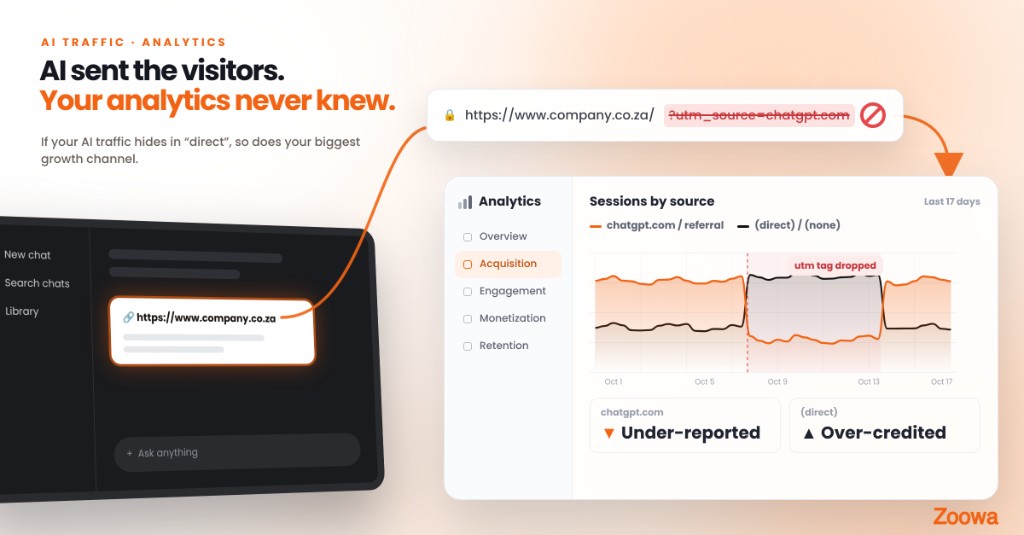
The issue appears to have started with the launch of GPT-6 in early October. Links in ChatGPT answers began opening without the utm_source=chatgpt.com tag that OpenAI had been adding since June, and without a referrer. Analytics tools had nothing to identify the source, so they defaulted to “direct”.
One analysis of about 500 pages heavily dependent on ChatGPT traffic found ChatGPT referrals down about 31,000 visits a day between 9 and 13 October, while direct visits rose about 26,000 a day on the same pages. On 15 October the behaviour was confirmed as a bug, and tagging resumed.
Demand did not fall. Reporting did. The incident shows how dependent AI attribution is on a single tag that the AI platform controls, and how quickly AI traffic can disappear from view when that tag changes.
Background: how ChatGPT traffic is attributed
Analytics tools identify where a visitor came from using two signals, and ChatGPT traffic relies on both.
- The referrer. When someone clicks a link, the browser normally tells the destination site which page they came from. If that page is chatgpt.com, analytics can label the visit as a ChatGPT referral.
- The UTM tag. A small label added to the end of the link itself, such as
?utm_source=chatgpt.com. It travels with the click even when the referrer is stripped, which makes it the more reliable of the two.
When both are missing, analytics has no evidence of where the visit came from. It files the visit under “direct”, the bucket normally reserved for people who type an address, use a bookmark or click a link in an untracked app.
This matters because many businesses now use ChatGPT referrals as their main signal of AI’s influence on demand. Marketing teams report it, leadership tracks it, and budget decisions increasingly lean on it. Any break in tagging distorts all three at once.
Incident timeline
The disruption lasted about a week, from the GPT-6 launch to the confirmed fix on 15 October.
| Date | Event |
|---|---|
| June | OpenAI begins adding UTM tags to ChatGPT links, so websites can identify ChatGPT visits even without a referrer. |
| Early October | GPT-6 launches. Links in ChatGPT answers start opening without the UTM tag and without a referrer. |
| 9 October | Practitioners begin seeing sharp drops in ChatGPT referral traffic, with matching rises in direct traffic. |
| 9 to 13 October | Analysis of about 500 ChatGPT-dependent pages measures the shift: ChatGPT referrals down about 31,000 visits a day, direct up about 26,000. |
| 14 October | Search Engine Roundtable reports the issue. |
| 15 October | The behaviour is confirmed as a bug. ChatGPT links carry utm_source=chatgpt.com again. |
Root cause
The change was in how ChatGPT opened outbound links, and it removed both attribution signals at once.
According to Cedric Huesler of Adobe, GPT-6 opened links in a new window with the browser’s “noopener” and “noreferrer” settings switched on, and without the utm_source=chatgpt.com tag.
- “noreferrer” tells the browser not to pass the referrer, so the destination site cannot see that the visit came from chatgpt.com.
- The missing UTM tag removed the backup signal that had made ChatGPT traffic identifiable since June.
Either change alone would have reduced attribution. Together, they left analytics with no evidence of the source at all. Every affected click was therefore treated as a direct visit.
The fix on 15 October restored the UTM tag. Whether the referrer setting was also changed has not been publicly confirmed.
Impact analysis
The evidence points to relabelled traffic, not lost traffic: what left the ChatGPT bucket arrived in the direct bucket, on the same pages, with the same behaviour.
The main dataset comes from Cedric Huesler’s analysis of about 500 pages where ChatGPT normally drives at least 5% of visits. He compared 9 to 13 October with the week before.
| Signal | What was observed | What it suggests |
|---|---|---|
| ChatGPT referrals | Down about 31,000 visits a day | Attribution was lost at scale |
| Direct traffic | Up about 26,000 visits a day on the same pages | Most of the lost visits reappeared as direct |
| Search traffic | Down 7%, in line with sites generally | No unusual shift in other channels |
| Pages where direct rose | 2 in 3 of the pages that lost ChatGPT traffic, against roughly half the week before | The rise in direct tracked the ChatGPT loss page by page |
| Search on those same pages | Rose on only 45% of them | Direct, not search, absorbed the traffic |
| Mobile visitors new to the site | Rose from 36% to 44% of direct visitors, against 55% typical for ChatGPT visitors | The new direct visitors looked like ChatGPT visitors |
The gap between the 31,000 lost and the 26,000 gained may reflect normal week-to-week variation and the general dip across channels. The analysis does not break this down, so treat it as unexplained rather than as a sign that buyers stopped using ChatGPT.
For businesses, the practical impact was a reporting error, not a demand problem. Any team that compared AI referrals across that week, or reported October AI performance without adjusting, will have understated AI’s contribution and overstated direct traffic.
Other signals during the window
Other practitioners saw the same drop, and at least one noticed changes in OpenAI’s crawler activity at the same time.
SEO consultant Sébastien Billard reported on X that from 9 October he saw a sharp drop in ChatGPT human traffic, and also a drop in visits from ChatGPT-User, the agent that fetches pages when a user asks ChatGPT something. Over the same period, from 7 October, he saw traffic from OAI-SearchBot, OpenAI’s search crawler, increase.
These are one practitioner’s server observations, not a controlled study. They are still worth noting for two reasons:
- The crawler shift lines up with the GPT-6 launch. More search-crawler activity around a model release is consistent with OpenAI refreshing its index.
- A drop in ChatGPT-User visits is a separate signal from the tagging bug. The UTM issue affects how human clicks are labelled. A change in agent fetches would affect how often ChatGPT reads your pages when answering. Whether the two were linked has not been established.
The main takeaway is that a model launch can change several things at once: how links behave, how often pages are fetched and how sites are crawled. Monitoring only one of these gives a partial picture.
Resolution and open questions
On 15 October, Huesler updated his analysis to say the behaviour was a bug and that ChatGPT links were carrying utm_source=chatgpt.com again. Search Engine Roundtable updated its report the same day.
Several questions remain open:
- No detailed public explanation. The bug confirmation came through industry observers. A full account of what changed and why has not been published.
- Exact start date. The drop is measured from 9 October, but the link change may have begun with the GPT-6 rollout a few days earlier.
- The referrer. It is not confirmed whether the “noreferrer” behaviour was also reversed, or only the UTM tag restored.
- Missing data is not recovered. Visits recorded as direct during the window stay as direct in historical reports. Analytics tools do not reclassify them retroactively.
- Wider coverage. The main dataset covers about 500 pages. How evenly the effect hit different industries, countries or devices is unknown.
Implications for measurement
The incident exposed four weaknesses in how most businesses measure AI’s effect on their traffic.
- Attribution depends on a tag the business does not control. ChatGPT referral data exists because OpenAI chose to add a UTM tag in June. A single change on OpenAI’s side removed it overnight. Any metric built on that tag inherits that fragility.
- “Direct” is a blind spot, not a channel. Direct traffic is where analytics puts visits it cannot explain. When AI attribution breaks, AI traffic lands there and looks like brand strength or returning customers. Rising direct traffic deserves scrutiny, not celebration.
- Model launches are measurement events. GPT-6 changed link behaviour and, by at least one account, crawler and fetch activity. Major AI model releases should be treated like search engine algorithm updates: expected to move numbers, and checked before results are reported.
- Clicks are the smallest part of AI’s influence. Even with perfect tagging, referral data only counts visitors who clicked through. It does not capture buyers who got their answer inside ChatGPT, or who were recommended a competitor and never arrived. The tagging bug briefly hid the visible part of AI traffic; the invisible part is hidden all the time.
Referral data is a useful signal of AI’s impact, but a business that relies on it alone is measuring AI through a keyhole.